

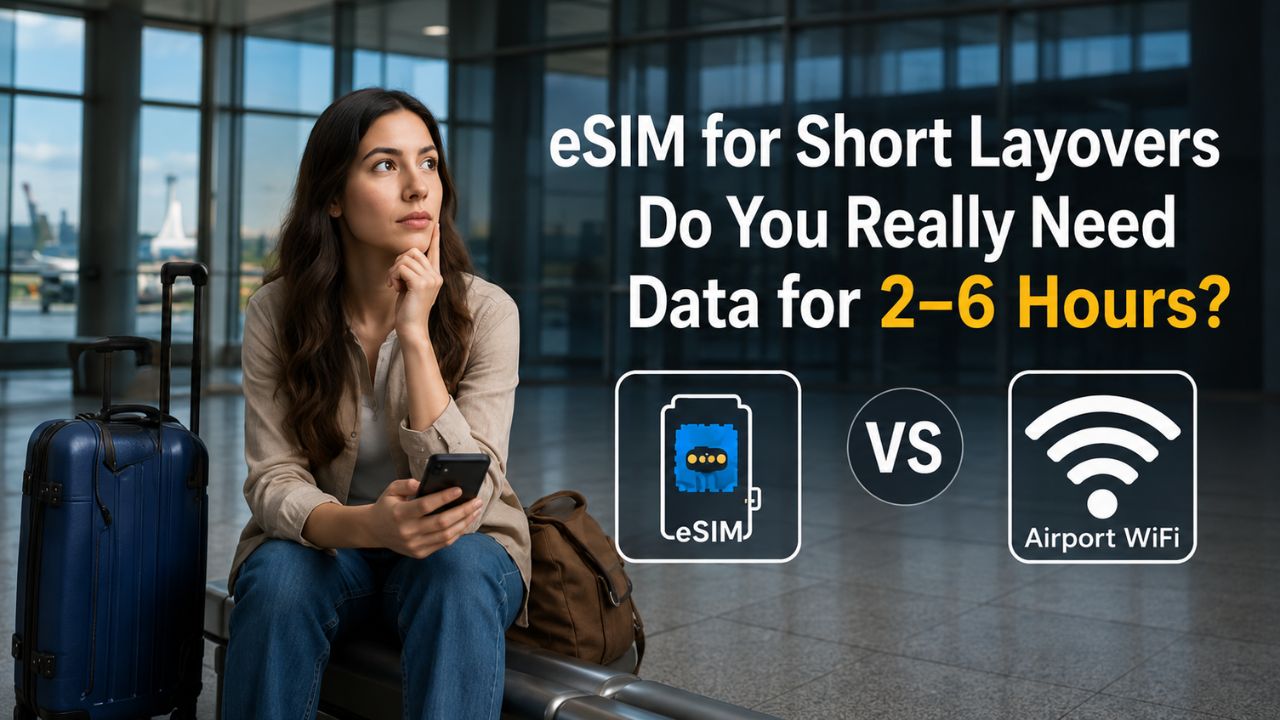
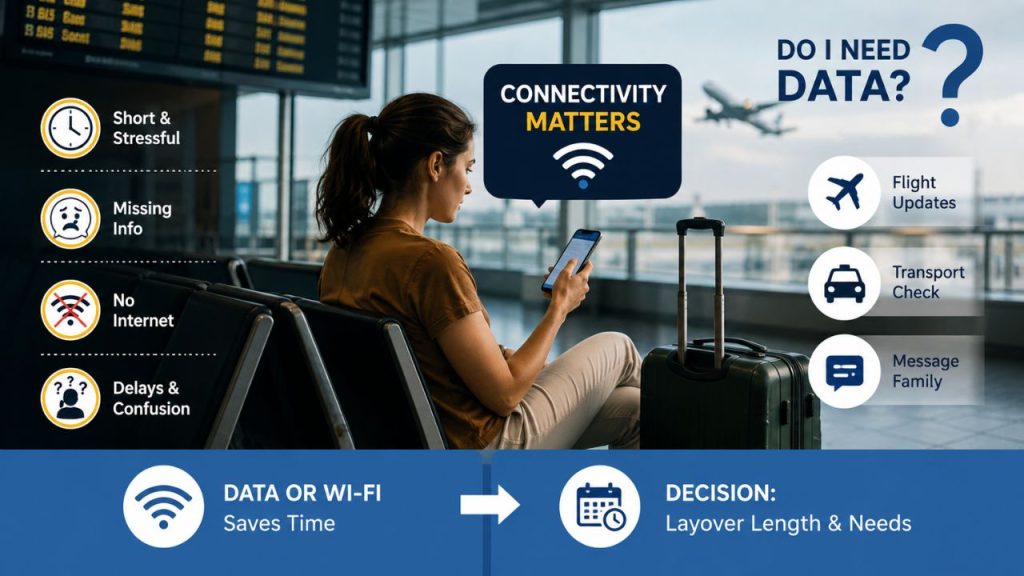
A layover in transit is often short but stressful. When time is tight, connectivity matters. At an airport, you might wonder: “Do I need data during an airport layover?” Travelers often turn on their devices right after landing. They check flight updates, arrange ground transport, or message family. For example, real concerns like gate changes or missed connections demand quick online checks. Without the Internet, passengers face delays and confusion. Therefore, having some data or a reliable Wi-Fi connection can save time. In practice, the decision comes down to your layover length and needs. An eSIM for short layovers helps you get online quickly for gate updates, boarding details, OTT messages on WhatsApp/Google, and essential travel apps—without relying on unpredictable airport Wi‑Fi.
Do I Need an eSIM for a Short Layover?
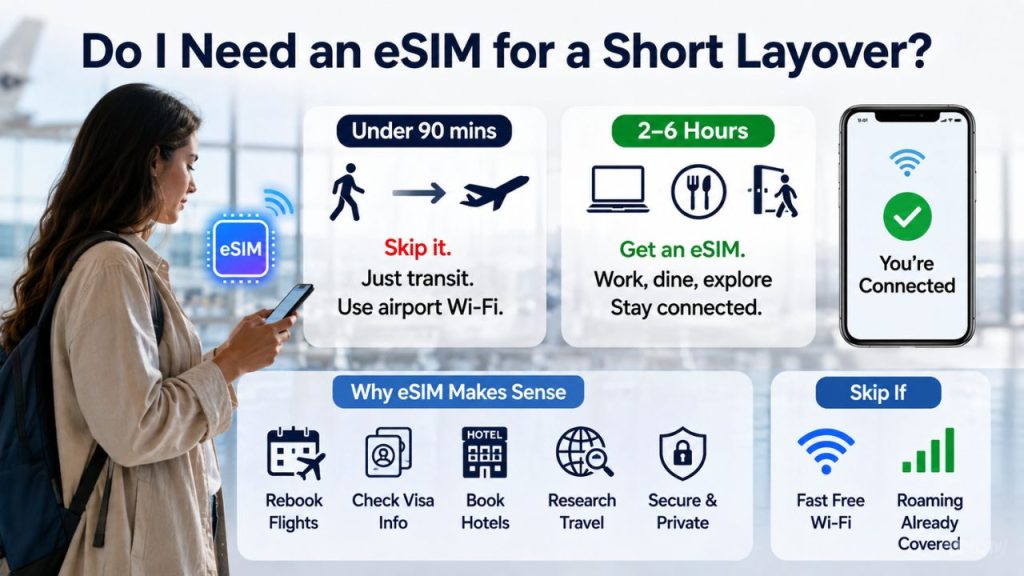
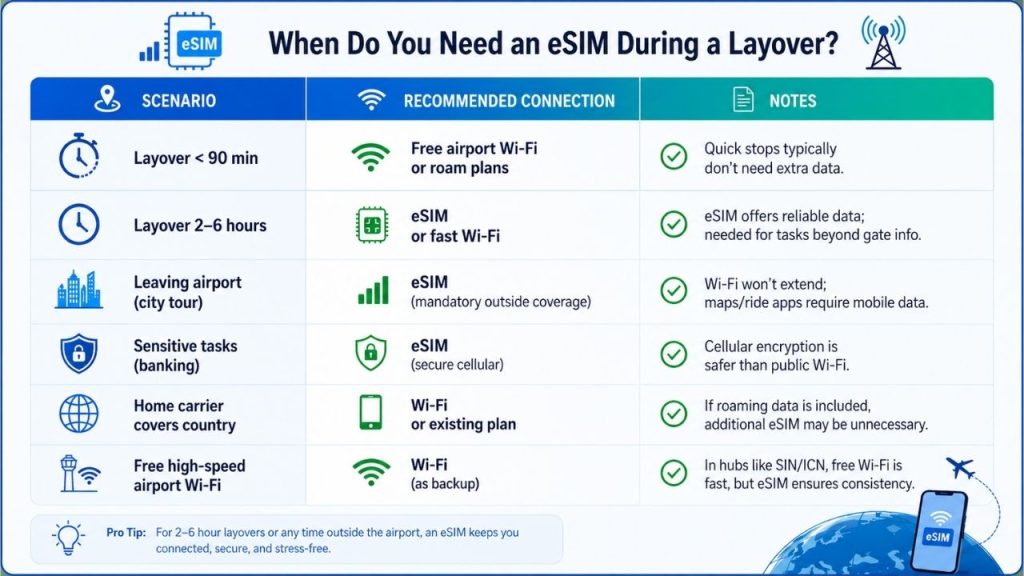
You might ask: “Do I need an eSIM for a layover?” The answer depends on your plan. A transit layover under 90 minutes usually doesn’t justify buying data. You spend most time walking or waiting for your next flight. However, layovers from 2 to 6 hours change the game. In that window, you have time to work, grab food, or even leave the terminal briefly. For these longer waits, having data can be a smart choice. For instance, if you need to rebook a flight, research visa info, or book a hotel, an eSIM provides immediate, personal Internet. In fact, experts recommend an eSIM if a layover exceeds 2 hours. Conversely, skip it if the airport offers fast free Wi-Fi or your carrier already covers the country.
Airport Wi-Fi vs eSIM for short layovers: Pros and Cons
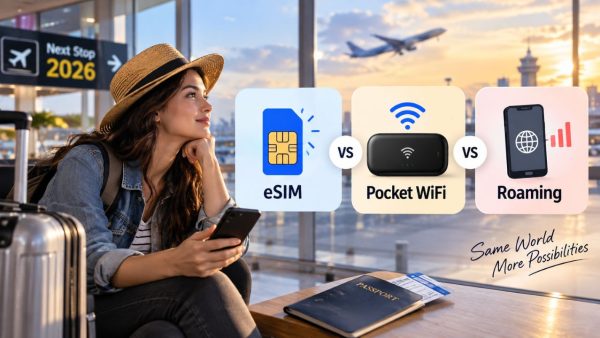
Airport Wi-Fi is usually free, but it has limits. Many hubs cap free Wi-Fi to 30–60 minutes or require repeated logins. Connection speeds can drop when hundreds of travelers join one network. Public Wi-Fi also raises security concerns: it is often unsecured and vulnerable to attacks. In contrast, an eSIM provides encrypted cellular data immediately. Cellular signals do not congest like shared Wi-Fi. Travelers find that a 1 GB eSIM plan (about $3–$5) delivers faster, more secure connectivity at the same price or less than airport Wi-Fi tiers. Moreover, an activated eSIM stays on the whole time—no need to hunt for networks or enter passwords. In fact, experts note “a cellular eSIM connection typically delivers 20–80 Mbps on 4G LTE,” far outpacing many free Wi-Fi speeds. Therefore, if you have tasks like checking banking apps or video calling, eSIM often wins.
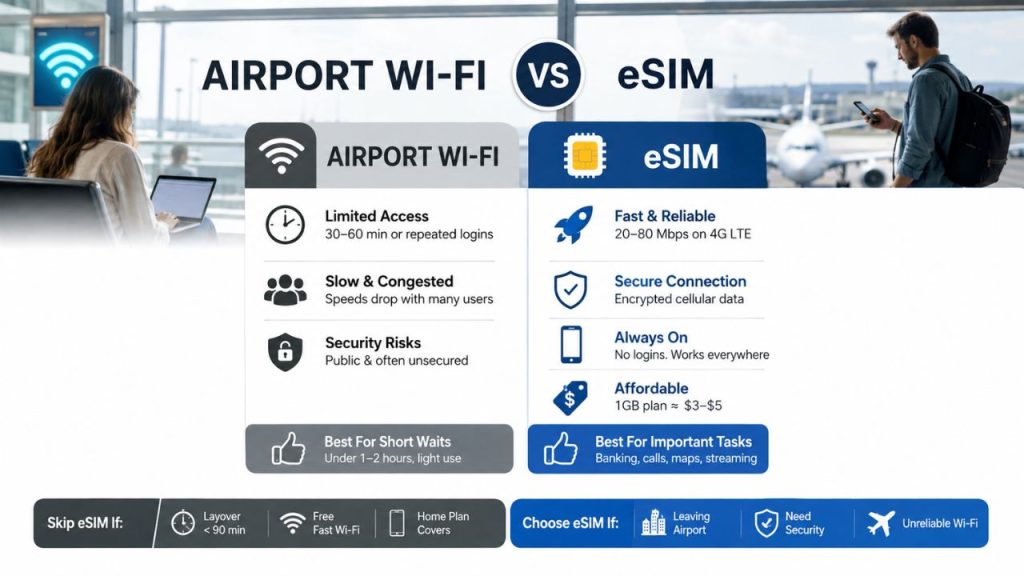
However, Wi-Fi still has a place. For very short wait (under 1–2 hours) or if you only need minimal info (gate changes), reliable airport Wi-Fi may suffice. On average, airport Wi-Fi works well in big hubs like Singapore Changi or Seoul Incheon, which offer free high-speed access. In those cases, you might comfortably skip buying data. Still, even in free Wi-Fi airports, having an eSIM can provide a backup. Many travelers use Wi-Fi for light tasks (e.g. email) and switch to eSIM for heavier use (e.g. streaming or calling).
When an eSIM Is Worth It
Buying an eSIM for layover transit makes sense in specific cases. The key factors are connection needs and plans:
1. Leave the airport: If you plan a quick city tour during a long layover, you need maps, ride-hailing, or translation tools. Airport Wi-Fi won’t cover you outside the terminal, but your eSIM will. In these cases, a short-term data plan is essential.
2. Need security: If you must handle sensitive tasks (banking, work email), cellular data is safer than public Wi-Fi.
3. Repeated flights: Frequent flyers often find eSIMs save them time and hassle on each trip.
4. Uncertain Wi-Fi: Some airports have weak Wi-Fi (like Istanbul or Doha); here, even a 2–3 hour layover justifies an eSIM.
By contrast, skip the eSIM if: your layover is under 90 minutes, the airport offers free fast Wi-Fi, or your usual mobile plan already covers that country. In short, evaluate your itinerary: “Do I need an eSIM for a layover?” If your wait is long, your tasks are important, or you might leave the terminal, then yes. Otherwise, you can rely on free Wi-Fi or your home network.
Best eSIM Plans for 2–6 Hour Layovers
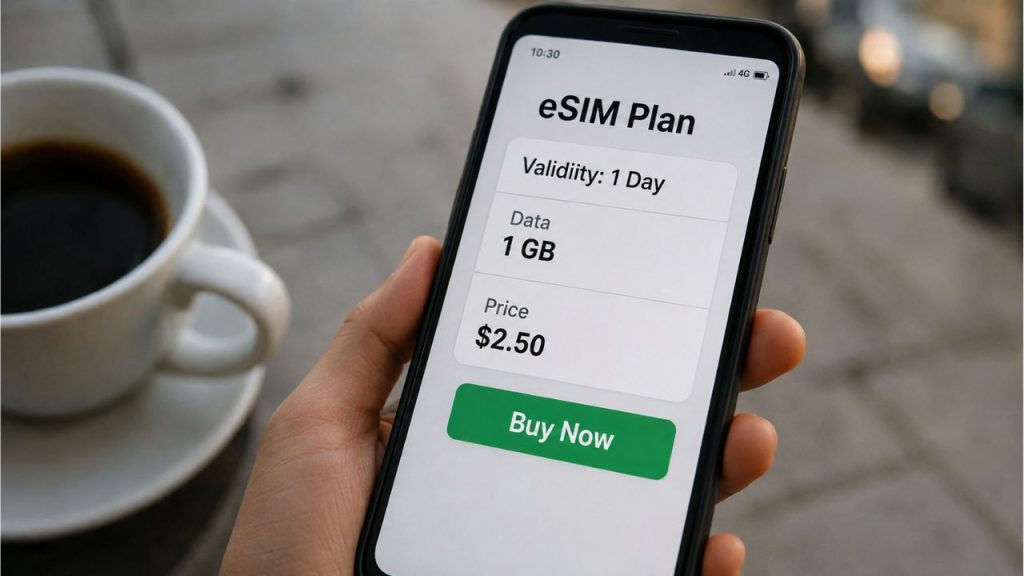
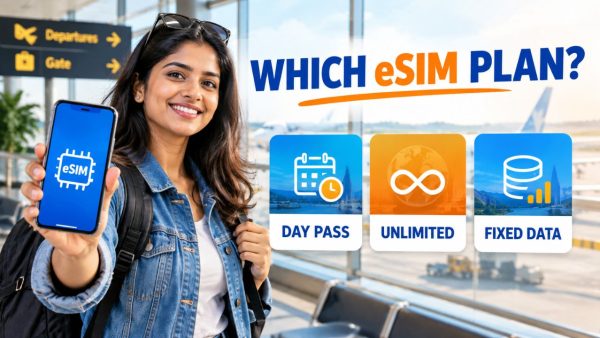
In recent years, travel eSIM providers have developed layover-friendly plans. Many offer 1-day or short-duration packages just for this scenario. For example, one-day data plans typically start around $3–$5 for 1 GB of data. This covers casual browsing, email, and light media for a few hours. Popular providers include Symbaa(from Hubbing Ecom), Nomad, Airalo, and Saily, which support quick in-app installations. Even if you only use 500 MB for a 4-hour stop, these low-cost plans can be cheaper and more reliable than buying extra Wi-Fi time in the terminal.
To pick the best short-layover eSIM: choose a provider with easy setup and wide coverage. Providers like Symbaa (from Hubbing Ecom), Saily or Airalo often top lists for short trips, because they activate in minutes and cover many regions. Holafly and Nomad frequently have promotions for 1-day unlimited or GB plans. (Note: price and availability vary by destination, so check app stores or our summary table below). For instance, one analyst found a 1 GB plan from many some sellers for about $2.50–$3.50, compared to $10+ for a full-day airport Wi-Fi pass.
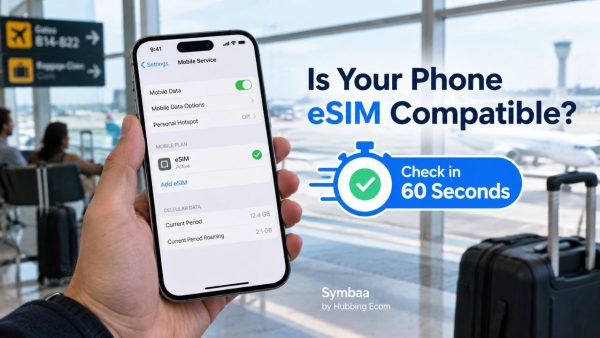
When considering eSIM for airport transit abroad, remember compatibility: ensure your device supports eSIM and that the plan covers the transit country. Most eSIM apps list covered countries (e.g. a Europe plan or global plan). If your layover and final destination are in different regions, make sure your plan either includes both or that you have a plan waiting for your final stop.
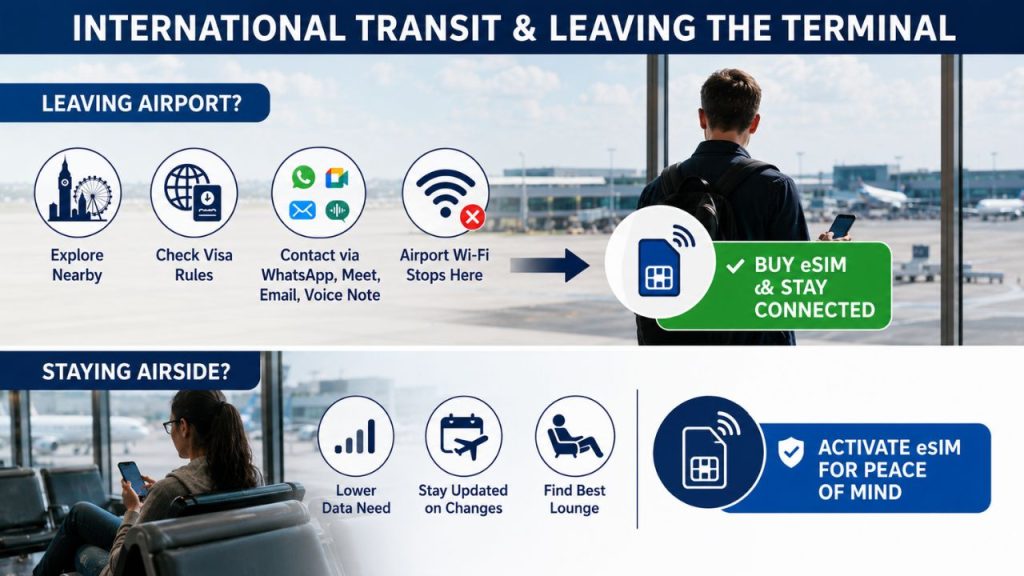
Consider International Transit and Leaving the Terminal aspect before deciding to by an eSIM for short layovers
For international layovers or flights with extra travel time, an eSIM becomes especially valuable. Connecting flights abroad often require you to navigate unfamiliar terminals or even leave the airport for a visa run. In such cases, you should buy data. For instance, if you have 4–6 hours in London’s Heathrow and want to visit nearby areas, you’ll need data once outside. Airport Wi-Fi stops at terminal boundaries. In addition, some countries require transit visas even in the airport; having mobile data helps check visa rules and contact officials if needed.
On the other hand, some travelers may only stay onboard or at the gate. If your layover is simply to switch planes and you plan to stay airside, your data need is lower. However, even then, data can help with last-minute booking changes or finding the best lounge. For peace of mind on long transit layovers, many choose to activate their eSIM anyway. An eSIM for short layovers can help you stay connected quickly for maps, ride bookings, flight updates, or last-minute travel needs once you step outside the terminal.
Activation Tips and Timing: eSIM for layover
Before you land, make your eSIM setup faster. Install your eSIM profile before travel so that activation in transit takes seconds. If you wait until landing, expect a few minutes to install via Wi-Fi or your carrier’s data. Good apps (Symbaa, Airalo, Saily) can install instantly after purchase, but the best piece of advice is to install these apps before flying. Even if you activate after landing, it usually takes under 5 minutes.
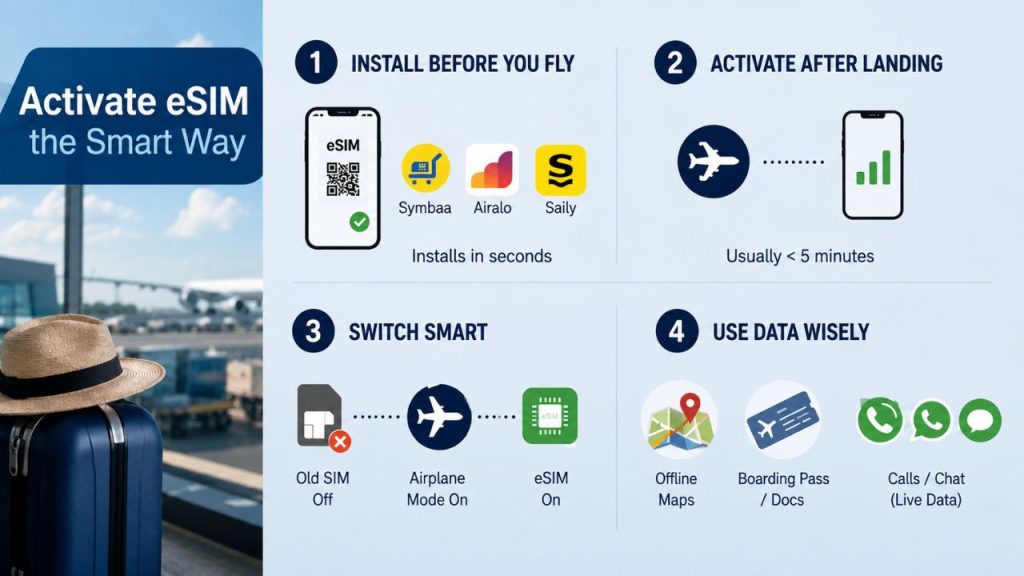
Another tip: turn on airplane mode when switching your SIMs. Disconnecting your old SIM (if any) and enabling the new eSIM often prevents roaming charges or conflicts. Once you have data, quickly use an offline map (Airplane Mode to save battery) and download any needed boarding passes or travel documents. This way, you use your eSIM for tasks that truly need live data (like calls or live chats) and rely on offline resources for static info.
Cost and Security Considerations : Airport Wi-Fi versus eSIM for short layovers
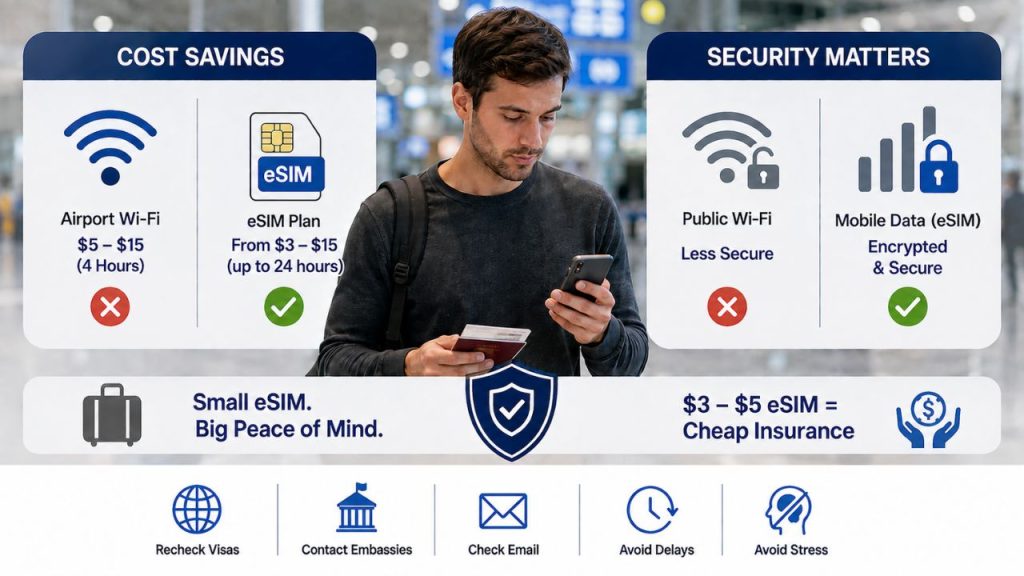
In short layovers, money often matters. As noted, many airports charge $5–$15 for short Wi-Fi passes. In comparison, a cheap eSIM is often cheaper. For example, one report shows that at London Heathrow, a 4‑hour Wi-Fi pass (if available) compares to about $3-$15 for an eSIM with faster speed. Over multiple trips, eSIM savings add up. Moreover, do not forget security: public Wi-Fi can leave you vulnerable. Using a mobile data plan means your connection is encrypted end-to-end. For anything sensitive (banking, work email), cellular is vastly safer.
Finally, think of it as insurance. Even if your layover is short, a small eSIM can solve unexpected hiccups. In one guide, an analyst pointed out that a $3–$5 eSIM is “cheap insurance against transit complications,” letting you recheck visas or contact embassies on the spot. In contrast, missing a connection or visa issue without data could cost much more in time and stress.
Quick Decision Guide: Airport WiFi or short layover eSIM
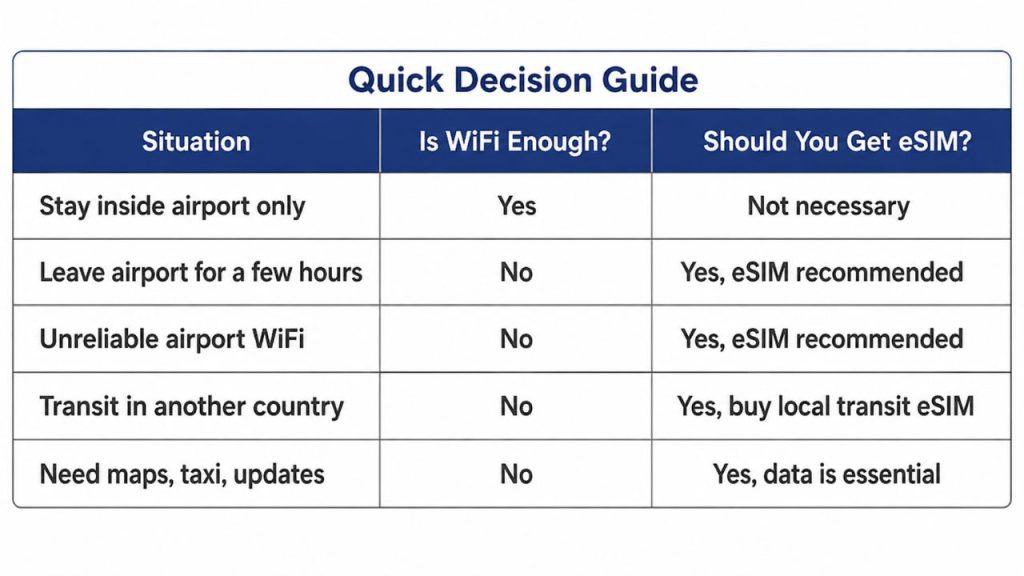
Choosing an eSIM for a layover depends on your travel plans and connectivity needs. If you stay inside the airport and have reliable WiFi, an eSIM may not be necessary. However, an eSIM for airport transit is recommended if you leave the airport, need maps, taxi apps, travel updates, or face unreliable airport WiFi. If you transit through another country, a local transit eSIM can provide convenient mobile data. For short layovers, an eSIM offers reliable connectivity when airport WiFi is not enough.
Summary and Recommendations: airport WiFi vs eSIM
Conclusion
In conclusion, a short layover eSIM can greatly ease travel stress for transits of 2–6 hours. It offers instant, secure data for checking flights, navigating terminals, or even stepping outside for a quick city break. However, it isn’t always mandatory. If your layover is brief or you’re at an airport with very good free Wi-Fi, you might skip it. Still, as a low-cost backup, purchasing a one-day plan is often worthwhile.
Stay connected with affordable eSIM data-CHECK COVERAGE: Consider using an eSIM data plan from a trusted provider rather than pricey roaming. Our travel eSIM app Symbaa (by Hubbing Ecom) provides a range of affordable short-term data plans perfect for layovers. With Symbaa, you can buy a 1-day eSIM in minutes and avoid high fees. By staying online, you gain flexibility and peace of mind—knowing you can book a hotel, call a taxi, or handle emergencies mid-transit. For your next trip, check out Symbaa or Hubbing Ecom for reliable eSIM options tailored to your layover needs.
Frequently Asked Questions (FAQs)
1. Do I need an eSIM for a layover?
It depends on your plan. If you stay inside the airport, WiFi may be enough. If you leave the airport, an eSIM is very useful.
2. Is airport WiFi enough for a layover?
Airport WiFi is useful for basic tasks. However, it can be slow, unstable, and not always secure.
3. Which is the best eSIM for a short layover?
Look for short-validity plans with good speed and coverage. Hubbing Ecom and Symbaa offer the best options.
4. Do I need data during an airport layover?
Yes, if you want to use maps, book rides, or stay updated on flight changes.
5. Can I use my eSIM in international transit airports?
Yes, if the plan covers the transit country. Otherwise, get an eSIM for security.
6. How much does a short layover eSIM cost?
Short plans start from as low as $1-$5, depending on the country and data.
7. Should I buy an eSIM before or after landing?
It is better to buy before you travel. Then activate it after landing.
You may like reading similar Blogs
Should I Install My eSIM Before Travel or After Landing? The Complete Answer
Global Travel eSIM Explained by a Telecom Professional
Should Data Roaming Be ON or OFF With a Travel eSIM? (The Answer Is Counterintuitive)
eSIM for Digital Nomads and Remote Workers: The Complete Connectivity Setup in 2026
Should I Install My eSIM Before Travel or After Landing? The Complete Answer
eSIM Security and Privacy: Is Your Data Safe When Traveling?
How to Use eSIM Abroad Without Missing Your Indian Bank OTP or UPI Alert
Complete eSIM Troubleshooting Guide — Why It’s Not Working & How to Fix It
How Much eSIM Data Do I Really Need? A Calculator for Every Type of Traveler
Is ‘Unlimited’ eSIM Really Unlimited? The Truth About Throttling & Hidden Data Limits
Travel eSIM vs Local SIM vs International Roaming: What Luxury Travelers Prefer Now
Crucial prerequisite of eSIM Utilisation: Unlocking Smooth Communication
12 Factors That Effect Your Data Speed On Foreign Trip
Why you should use eSIM and Wi-Fi Map in conjunction? On your international trip..
Which is better eSIM or International plan?
Pocket WiFi or eSIM? A comparison..
Is eSIM signal strength the same as a Physical SIM?
Why buy laptops with eSIM feature?
Can i change the APN Settings?
Can an eSIM and Physical SIM have the same number?
eSIM for Remote Workers and Digital Nomads
eSIM for Silent Roamers: Affordable Data Plans and Limitations
Subscribe to our YouTube channel and follow us on Instagram for more updates.
About the Author
Swatantra Ranjan is a telecom professional with over 15 years of experience in the global telecommunications industry having worked in India & Dubai, specializing in eSIM solutions, voice services, SMS, international roaming, Direct Inward Dialing (DID) numbers, virtual numbers, and sales/services experience in B2C/B2B banking industry. Having traveled to more than 20 countries, he combines deep technical expertise with firsthand international travel experience to create practical, accurate, and trustworthy content on global connectivity, mobile technology, and travel communications. His articles help travelers, businesses, and telecom professionals make informed decisions about staying connected efficiently and securely across the world. Check out LINKEDIN Profile
Leave a comment