

Planning an international trip usually means choosing an eSIM to stay connected. While comparing plans, you’ve likely seen providers advertising an Unlimited eSIM. It sounds straightforward—buy one plan and enjoy unlimited data throughout your trip.
However, many travelers notice their connection slowing down after a few days, even though they purchased an unlimited plan. Maps take longer to load, videos buffer, and uploading photos becomes frustrating. This often leads to one question:
Is unlimited eSIM really unlimited?
The short answer is yes—but not always at full speed.
Most unlimited eSIM plans provide unlimited total data, but many don’t offer unlimited high-speed data. Once you reach a certain usage threshold, your provider may reduce your internet speed under a Fair Usage Policy (FUP) or data throttling. The exact limit varies by provider. Some apply daily high-speed allowances, while others limit speeds after a larger amount of data has been used.
That doesn’t make unlimited plans misleading. For many travelers, they’re still the most practical option. The key is understanding how they work before you buy.
In this guide, you’ll learn what Unlimited eSIM really means, how eSIM throttling works, why providers use Fair Usage Policies, and what to check before choosing an unlimited travel eSIM.
What Does "Unlimited" Actually Mean?
The word unlimited is often misunderstood.
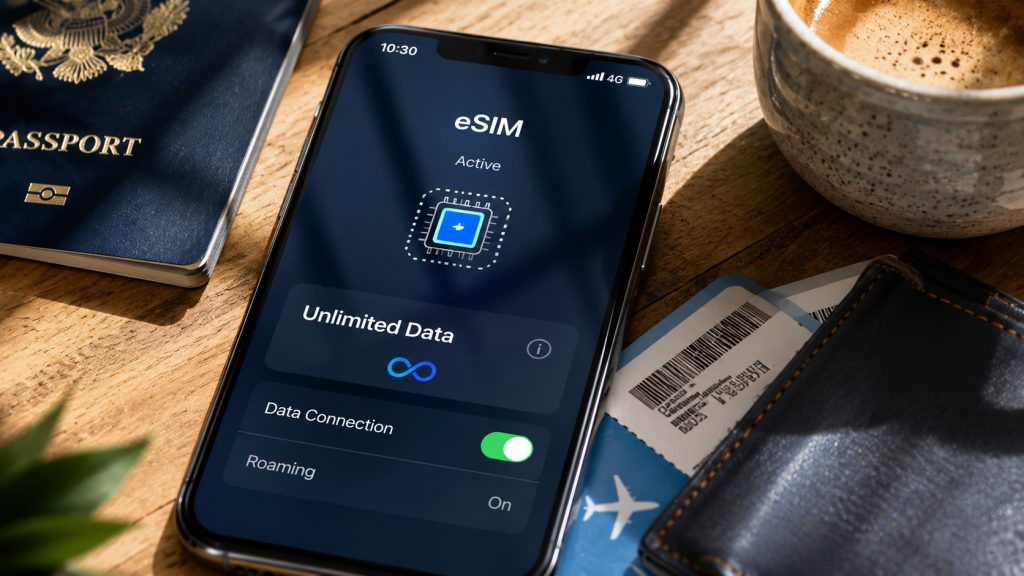
In most cases, an Unlimited eSIM lets you keep using mobile data throughout your trip without cutting off your connection. However, it doesn’t always guarantee maximum speed for the entire validity of the plan.
Most providers divide unlimited plans into two stages:
- High-speed data.
- Reduced-speed data after reaching a usage threshold.
This approach helps providers manage network capacity while allowing customers to remain connected.
Unlimited Data vs Unlimited High-Speed Data
Understanding this difference helps avoid disappointment.
Unlimited data means your connection usually continues working even after you’ve reached a usage limit.
Unlimited high-speed data means your connection stays at full speed without planned slowdowns. Very few travel eSIM plans offer this because mobile network capacity is shared among many users.
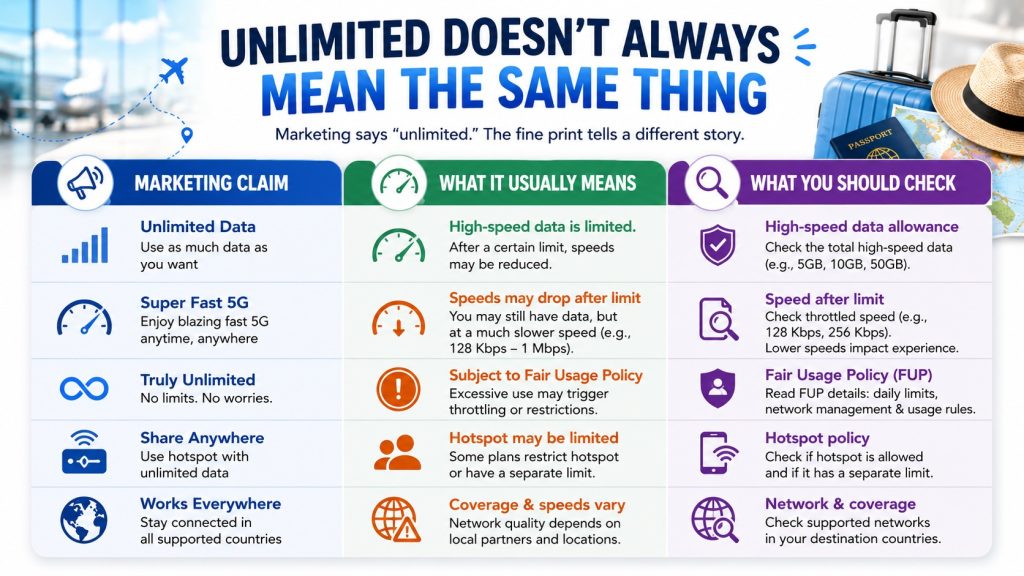
Rather than focusing only on the word “unlimited,” always check how the provider manages high-speed data.
Why Providers Use the Term "Unlimited"
Unlimited plans aren’t unique to travel eSIMs. Mobile carriers worldwide use Fair Usage Policies because network capacity is shared among all users.
If a small number of customers continuously consume very large amounts of data, network performance can suffer for everyone. Fair Usage Policies help balance network resources while allowing customers to stay connected.
Before purchasing an unlimited travel eSIM, check whether the provider clearly explains:
- High-speed data allowance
- Fair Usage Policy
- Speed after throttling
- Hotspot restrictions
- Country-specific conditions
Transparent plan information makes it much easier to compare providers and choose the right plan.
What Is Data Throttling?
If you’ve ever wondered why your unlimited eSIM suddenly became slow, the answer is often data throttling.
Data throttling is the intentional reduction of internet speed after certain usage conditions are met. Instead of disconnecting your service, your provider keeps you online at a lower speed.
For example, if your plan includes 5 GB of high-speed data each day, speeds may decrease after you reach that allowance and return to normal when the daily limit resets.
Think of it like a busy highway. As traffic increases, vehicles continue moving, but more slowly. Mobile networks work in a similar way by allocating available bandwidth across many users.
Reduced speeds vary by provider. Basic tasks such as messaging, navigation, email, and light browsing usually remain usable, while activities like HD streaming, large uploads, and high-quality video calls may become noticeably slower.
Because policies differ between providers, always review the Fair Usage Policy before purchasing an Unlimited eSIM.

What Is a Fair Usage Policy (FUP)?
A Fair Usage Policy (FUP) explains how providers manage network usage on unlimited or high-data plans.
Its purpose isn’t to stop you from using your data. Instead, it helps ensure network resources remain available for everyone sharing the same infrastructure.
Rather than disconnecting customers after reaching a usage threshold, providers usually reduce speeds while keeping internet access active. This allows essential services such as navigation, messaging, email, and travel apps to continue working.
Not every Unlimited eSIM follows the same Fair Usage Policy. Some plans reset high-speed allowances every 24 hours, while others apply limits across the entire validity period. Certain plans also include hotspot restrictions or country-specific conditions.
Understanding the Fair Usage Policy is the key to comparing unlimited travel eSIM plans accurately. Instead of asking whether a plan is unlimited, ask how that unlimited data is managed.
In the next section, we’ll examine the most common unlimited eSIM restrictions, how they affect everyday travel, and what you should check before making a purchase.

Common Types of Unlimited eSIM Restrictions
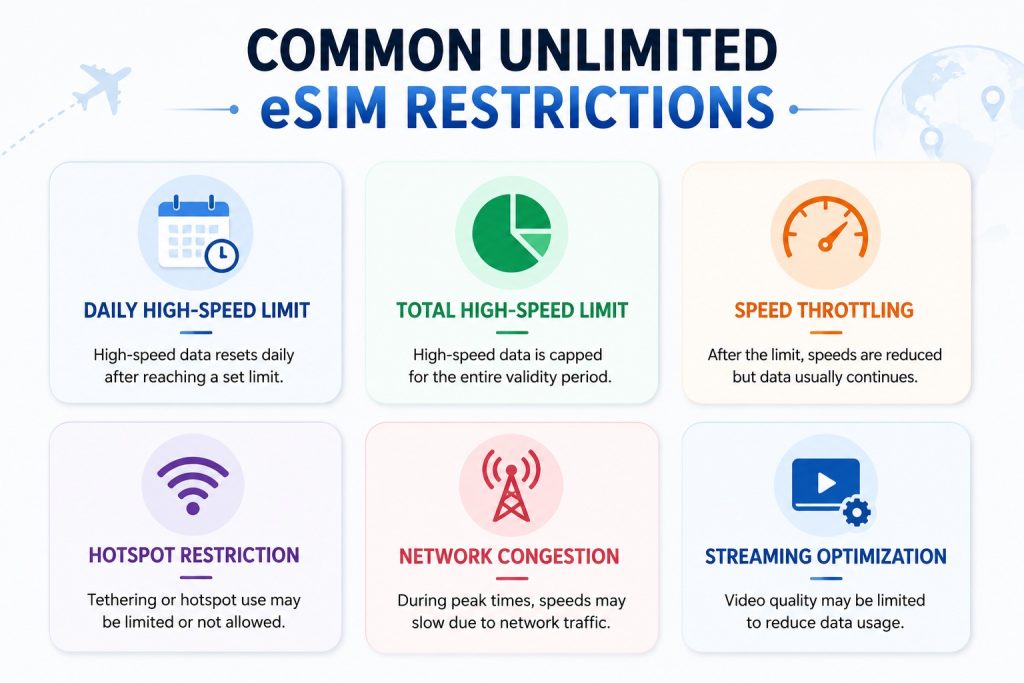
Not every Unlimited eSIM works the same way. Two plans may both advertise unlimited data but deliver very different experiences once you begin using them.
Some providers reduce speeds after a daily high-speed allowance, while others apply limits across the entire plan. Certain plans also restrict hotspot usage or manage traffic during periods of heavy network congestion.
Understanding these differences helps you compare plans more effectively.
Daily High-Speed Data Limits
Many unlimited travel eSIM plans include a daily high-speed allowance.
Once you use that allowance, your internet usually continues working at a lower speed until the next daily reset. Travelers with moderate usage may never notice this limit, but heavy users who stream videos, upload content, or work remotely can reach it much sooner.
Total High-Speed Data Limits
Instead of resetting high-speed data every day, some providers apply one high-speed allowance across the entire validity of the plan.
After reaching that limit, speeds may remain reduced for the rest of your trip. If you’re travelling for several weeks, checking whether the allowance resets daily or applies to the whole plan is essential.
Speed Throttling
Speed throttling reduces your connection speed without disconnecting your service.
Messaging, navigation, and email often continue working well, while activities such as HD streaming, large downloads, and cloud backups may become noticeably slower.
Because every provider applies different policies, always review the Fair Usage Policy before purchasing an Unlimited eSIM.
Hotspot Restrictions
Unlimited data doesn’t always mean unlimited hotspot usage.
Some providers limit tethering separately from your phone’s data allowance. If you plan to work from a laptop, connect multiple devices, or share your connection with family members, verify the hotspot policy before buying.
Network Congestion Prioritization
Mobile networks become busier at certain times and locations.
During periods of heavy demand, providers may temporarily prioritize traffic to keep the network stable. You might notice slower speeds in crowded airports, stadiums, festivals, or popular tourist destinations, even if you haven’t reached your data allowance.
Video Streaming Restrictions
Some unlimited plans optimize video streaming separately from general internet traffic.
Instead of slowing every online activity, they may automatically reduce streaming quality while allowing messaging, browsing, and navigation to continue performing normally.
What Can You Actually Do After Throttling?
One of the biggest frustrations for travelers is that providers rarely explain what reduced speeds actually mean in everyday use.
The answer depends on both your provider and how you use your phone.
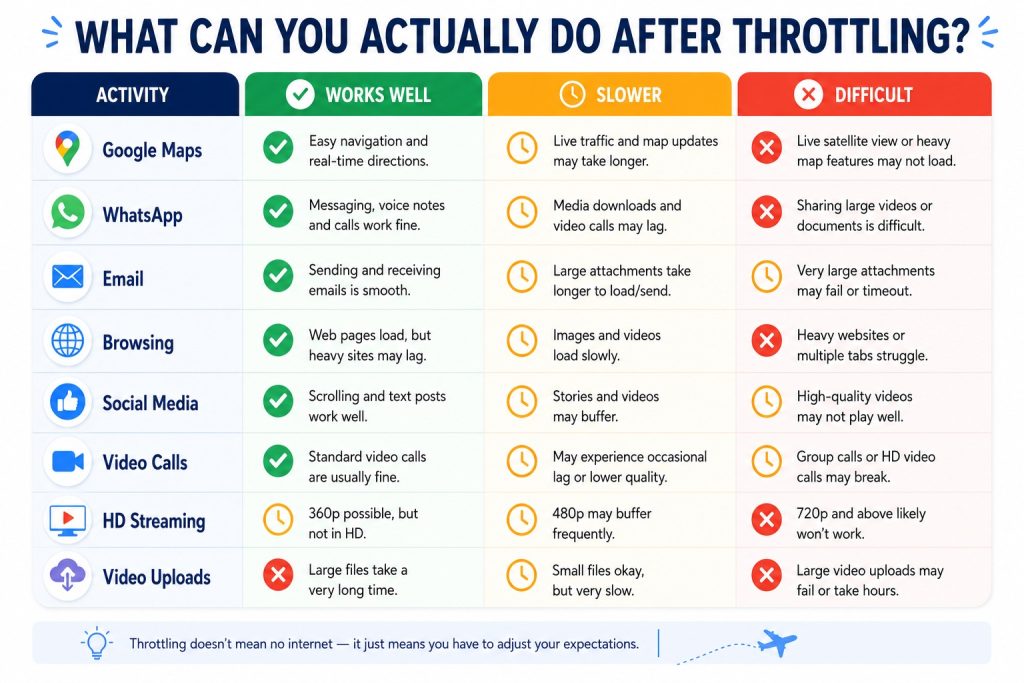
Actual performance varies depending on your provider, network conditions, and throttled speed.
In general:
- Navigation, messaging, and email usually continue working well.
- Browsing and social media may feel slower, especially with image-heavy content.
- Video calls may lose quality or become unstable.
- HD streaming, cloud backups, and large uploads are typically affected the most.
If your trip mainly involves maps, messaging, and travel apps, throttling may have little impact. However, creators, digital nomads, and heavy streamers should pay close attention to the Fair Usage Policy before choosing an unlimited travel eSIM.
How to Compare Unlimited eSIM Plans Before Buying
Choosing an Unlimited eSIM isn’t just about finding the cheapest plan. The real difference lies in how each provider manages high-speed data after you begin using it.
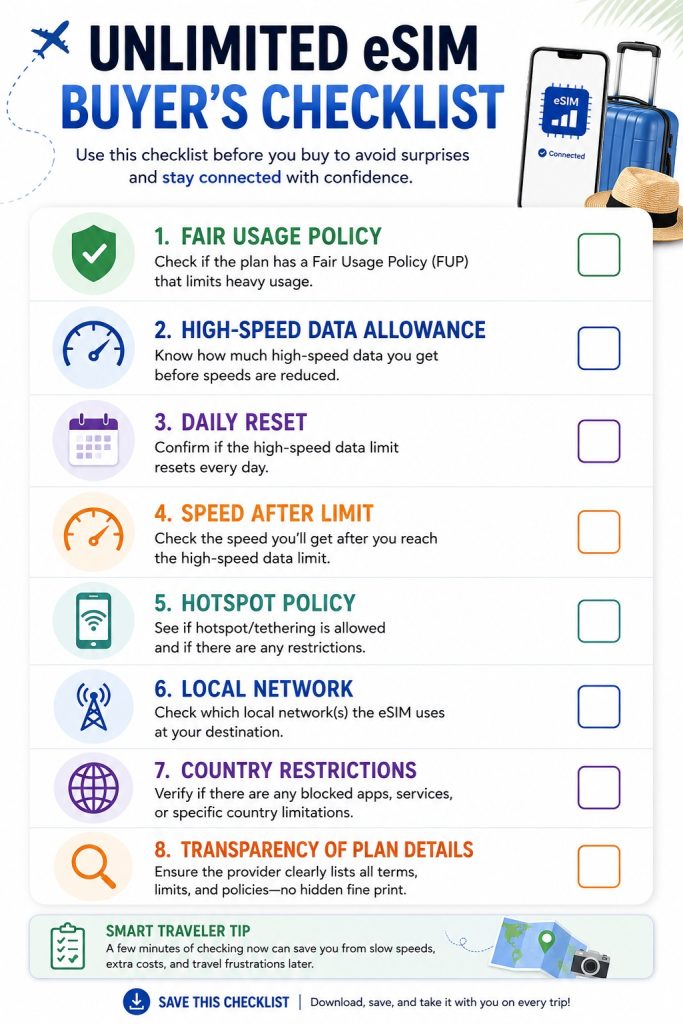
Before buying, compare these important details:
- Does the plan include a Fair Usage Policy (FUP)?
- How much high-speed data is included?
- Is the allowance daily or for the entire plan?
- What speed applies after the limit is reached?
- Does the high-speed allowance reset every 24 hours?
- Are hotspot or tethering features restricted?
- Which local mobile network does the eSIM use?
- Are there country-specific limitations?
The more transparent a provider is about these details, the easier it is to choose the right plan for your travel style.
Warning Signs to Watch For
Read the plan carefully if it:
- Advertises “Unlimited Data” without explaining its Fair Usage Policy.
- Doesn’t specify what happens after the high-speed allowance is used.
- Hides important restrictions in lengthy terms and conditions.
- Doesn’t clearly explain hotspot limits.
- Uses vague phrases such as “speed may vary” without additional context.
Transparency is often a sign of a trustworthy provider.
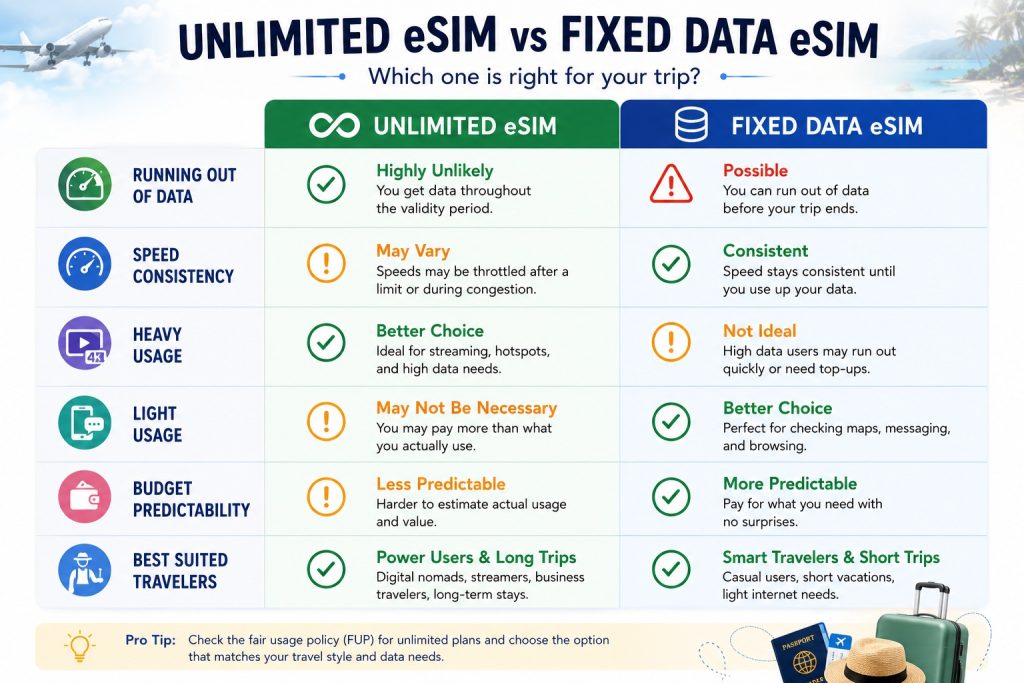
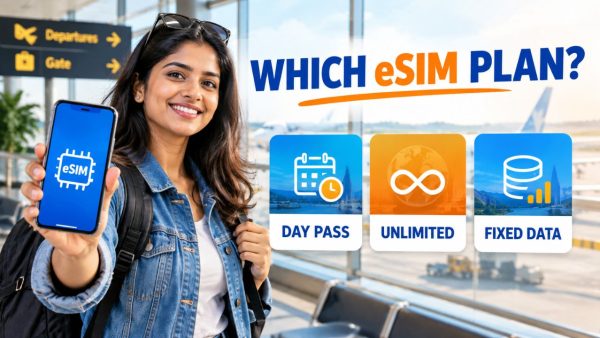
Unlimited eSIM vs Fixed Data eSIM: Which Should You Choose?
Neither option is automatically better. The right choice depends on how you travel.
Unlimited eSIM Buyer's Checklist
Before purchasing any unlimited travel eSIM, use this checklist.
Frequently Asked Questions
Is unlimited eSIM really unlimited?
Most unlimited eSIM plans provide unlimited total data. However, many reduce internet speeds after a certain amount of high-speed data has been used under a Fair Usage Policy.
What is data throttling?
Data throttling is the intentional reduction of internet speed after you reach a usage threshold. Your connection usually continues working, but at a slower speed.
Why does my unlimited eSIM become slow?
The most common reason is that you’ve reached your provider’s high-speed data allowance. Temporary network congestion can also affect performance.
Can I still use Google Maps and WhatsApp after throttling?
Usually, yes. Navigation, messaging, and email generally continue working well because they require relatively little bandwidth.
Are hotspot restrictions common?
Some providers limit hotspot usage separately from your phone’s data allowance. If you rely on tethering, always check the plan details before purchasing.
Is an unlimited eSIM better than a fixed-data eSIM?
It depends on your travel habits. Unlimited plans offer peace of mind for heavier or unpredictable usage, while fixed-data plans often provide better value for lighter users.
Final Thoughts
An Unlimited eSIM can be an excellent choice for international travel, but “unlimited” doesn’t always mean unlimited high-speed data.
Many providers use a Fair Usage Policy (FUP) to manage network resources by reducing speeds after a certain amount of high-speed data has been used. Understanding these policies before you buy helps you avoid unexpected slowdowns and choose a plan that matches your travel needs.
Instead of comparing providers based only on price or the word “unlimited,” look at the details that matter most—high-speed data allowances, throttled speeds, hotspot policies, network partners, and overall transparency.
A few minutes of research before your trip can help you stay connected with confidence throughout your journey.
You may like reading similar Blogs
Complete eSIM Troubleshooting Guide — Why It’s Not Working & How to Fix It
How to check eSIM Data usage on iPhone?
Why you should use eSIM and Wi-Fi Map in conjunction? On your international trip..
12 Factors That Effect Your Data Speed On Foreign Trip
eSIM vs public WiFi vs VPN: A Comparison of Internet Access Methods
Can i change the APN Settings?
Can an eSIM and Physical SIM have the same number?
Is eSIM signal strength the same as a Physical SIM?
Pocket WiFi vs eSIM in Japan: Pros and Cons for Tourists
WiFi Calling vs Cellular: Which One’s Better for You?
Top eSIM Data Plans for Seafarers: Stay Connected Anywhere at Seaports
How International Data eSIMs Keep Pilots and Airline Crew Connected Across Borders
eSIM for Silent Roamers: Affordable Data Plans and Limitations
How to Use eSIM Abroad Without Missing Your Indian Bank OTP or UPI Alert
Should Data Roaming Be ON or OFF With a Travel eSIM? (The Answer Is Counterintuitive)
Affordable eSIM for Singapore: Safe High‑Speed Data for International Tourists
eSIM for Long-Term Travel: Managing Data, Expiry, and Top-Ups
eSIM for Business Travelers: Secure Data and Remote Work Tips
Subscribe to our YouTube channel and follow us on Instagram for more updates.
Leave a comment