

Planning one trip across four countries feels exciting, but staying connected often feels confusing. This guide compares the best eSIM for Southeast Asia so you avoid roaming shocks. You will also see country picks, real prices, and a step-by-step activation guide. By the end, you will know which plan fits Nepal, Sri Lanka, the Philippines, and Bali.
What Is An eSIM And Why It Matters
An eSIM is a digital SIM card built into your phone. So, you skip the plastic chip entirely. Instead of visiting a shop, you scan a QR code and get online fast. This matters for Indian travellers who land in Kathmandu, Colombo, Manila, or Denpasar without a local number. Unlike a physical SIM, there is nothing to lose or damage during transit.
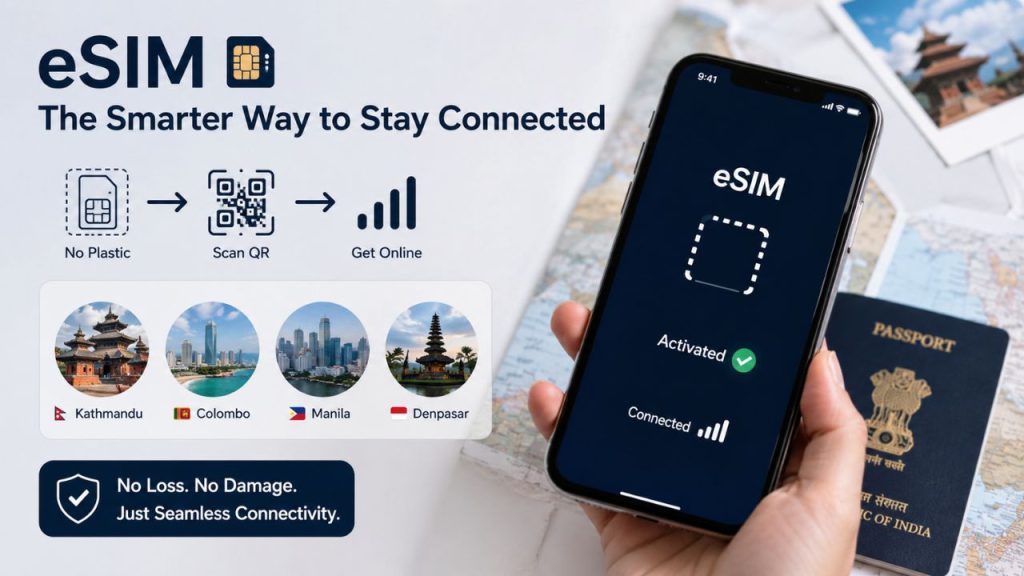
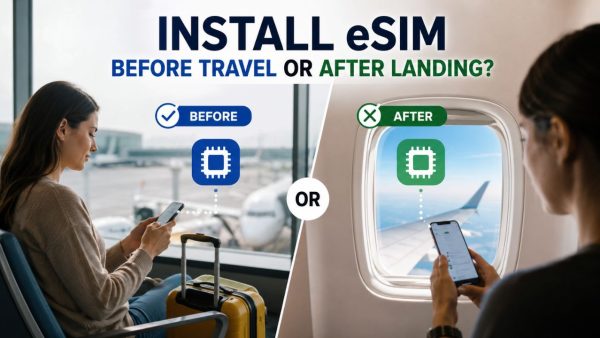
Consequently, most modern iPhones and Android flagships already support eSIM technology. Therefore, first-time users only need Wi-Fi to install the profile before departure. Moreover, an eSIM for Nepal/Global eSIM or Bali removes the airport counter queue after a long flight. As a result, you save time, avoid overpriced roaming, and stay reachable from arrival. Many companies include Nepal in their Global eSIM package.
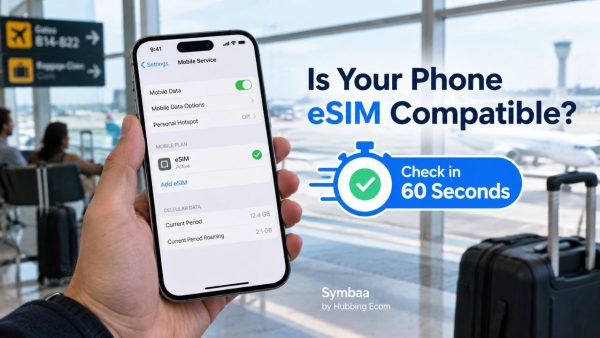
Additionally, many first-timers worry about compatibility, so checking your device model helps avoid disappointment. Furthermore, eSIM profiles can be stored for future trips without repurchasing. Hence, frequent travellers to Southeast Asia find eSIMs far more practical than juggling physical cards. Booking early also lets you compare seasonal discounts around holidays.
Country-By-Country Network And Coverage Comparison
Coverage varies sharply across these four destinations, so local terrain shapes expectations. In Nepal, Ncell and NTC cover Kathmandu and Pokhara well. However, signal thins out near Everest Base Camp trail sections. So, trekkers searching for the best eSIM/Global eSIM for Everest Base Camp trek Nepal should expect patchy 3G/LTE. Signal fades fast above Namche Bazaar.
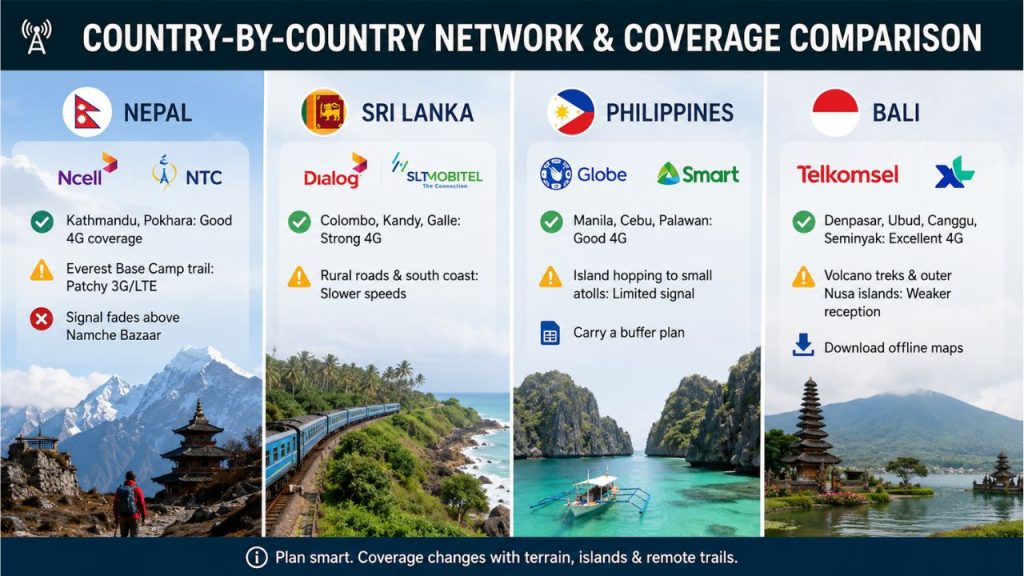
Meanwhile, Sri Lanka’s Dialog and Mobitel networks offer strong 4G in Colombo, Kandy, and Galle. However, rural tea-estate roads and southern coastal stretches sometimes drop to slower speeds. Similarly, the Philippines presents island-hopping challenges, since towers cluster around Manila, Cebu, and Palawan. Consequently, anyone island hopping between smaller atolls should carry a buffer plan.
Bali, by contrast, enjoys dense Telkomsel and XL coverage across Denpasar, Ubud, Canggu, and Seminyak. Nevertheless, remote volcano treks and far-flung Nusa islands still see weaker reception. So, urban travellers rarely struggle, but adventure seekers should download offline maps beforehand. Overall, each destination rewards a little planning around its network quirks.
Price And Data Plan Comparison Table
Pricing differs by provider, duration, and data volume, so comparing side by side helps. Below is a comparison across Airalo, Holafly, Yesim, Saily, and Ubigi for each destination. Rates reflect published 2026 pricing .
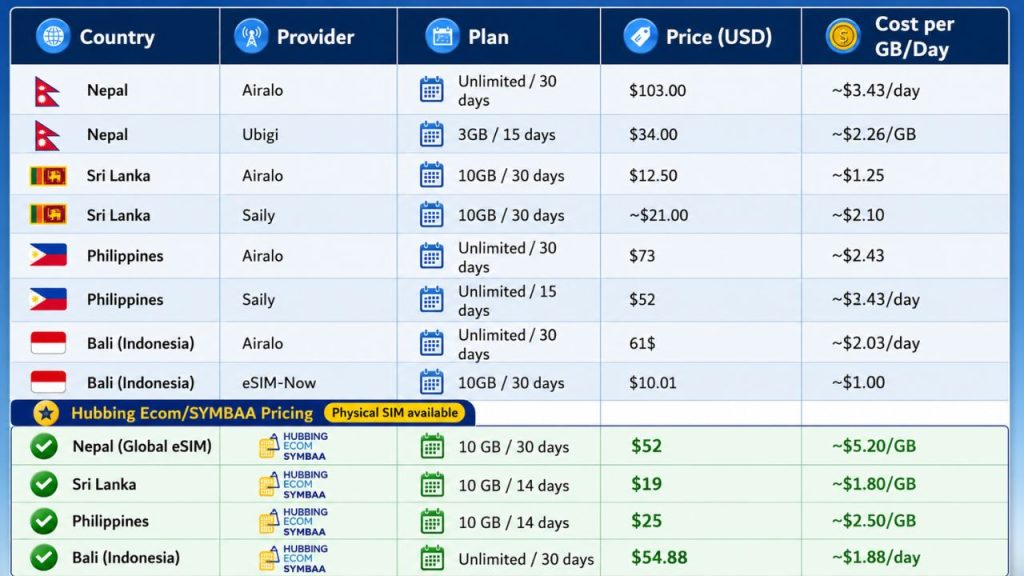
Price may vary due to FX changes/market changes. All Plans are subject to Fair usage policy and data speed may vary radio transmission, network strength, congestion etc
Clearly, an eSIM for Sri Lanka trip delivers the cheapest cost per gigabyte here. On the other hand, an eSIM for Nepal costs more per GB due to mountain infrastructure limits. Meanwhile, for the cheapest eSIM for Sri Lanka trip, compare 10GB plans before booking. Notably, Bali plans have become more competitive as newer regional providers enter the market. Additionally, joining a provider’s loyalty program sometimes unlocks small discounts on repeat purchases. Notably, budget-conscious travellers should compare validity periods too, since shorter windows sometimes cost less overall.
Multi-Country Regional eSIM Versus Separate Country Plans
Since these four destinations often appear on one itinerary, travellers ask about regional coverage. A Global eSIM/one eSIM for Nepal Sri Lanka Philippines Bali multi-country plan avoids switching profiles at each border. However, regional plans usually cost more per GB than single-country options bought locally.
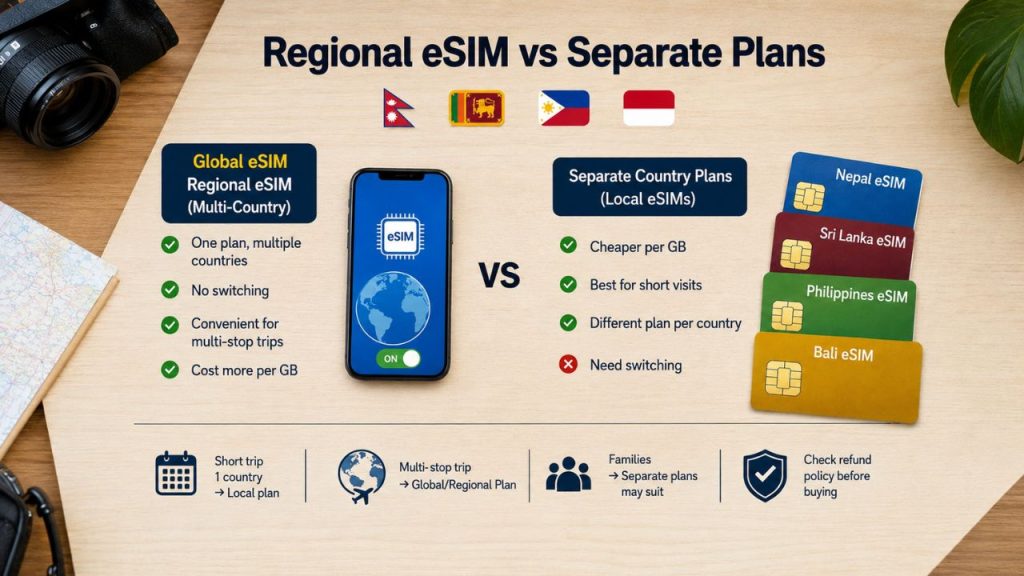
Therefore, short single-country visits suit dedicated plans, while long multi-stop trips favour regional bundles. Additionally, digital nomads hopping between cities gain convenience from one active profile. So, weigh your itinerary length against your data appetite before deciding. Similarly, checking your provider’s refund policy before buying protects you if plans fail to activate.
In contrast, families travelling together sometimes prefer separate plans, since usage differs per member. Ultimately, the right choice depends on how many borders you cross.
Real-World Speed And Performance Insights
Independent testers report that Airalo delivers consistent LTE speeds across Bali, Colombo, and Manila . Nepal’s Ncell network, meanwhile, shows slower throughput once you leave Kathmandu Valley. Consequently, users searching best eSIM for Bali 2026 unlimited data should confirm hotspot support first.
Speed naturally drops in mountainous or forested regions, regardless of provider choice. Still, most travellers report smooth video calls within city centres and resorts. Ultimately, urban connectivity stays reliable, while remote zones need realistic expectations and offline backups.
eSIM Versus Local Physical SIM Card
Buying a local SIM card often means airport queues, passport copies, and mandatory KYC forms. In Sri Lanka, tourists must register with ID at the airport counter, which takes time. Nepal requires similar paperwork, plus a passport photo, before activation.
By comparison, an eSIM activates instantly online, skipping paperwork for most nationalities-although you are required to send soft copies of passport, visa and ticket details to your seller . So, when people ask “eSIM vs local SIM card Sri Lanka which is better,” convenience wins clearly. However, physical SIMs sometimes offer cheaper unlimited local calling for long Philippines stays.
Meanwhile, Bali’s SIM counters at Denpasar airport also require identity checks, adding delay. Therefore, eSIMs remain faster whenever time matters more than saving a few rupees.
Step-By-Step Activation Guide
First, confirm your phone supports eSIM under “Add Cellular Plan” in settings. Next, purchase your plan online before departure, ideally using stable home Wi-Fi. Then, scan the QR code from your email, and label the new line.
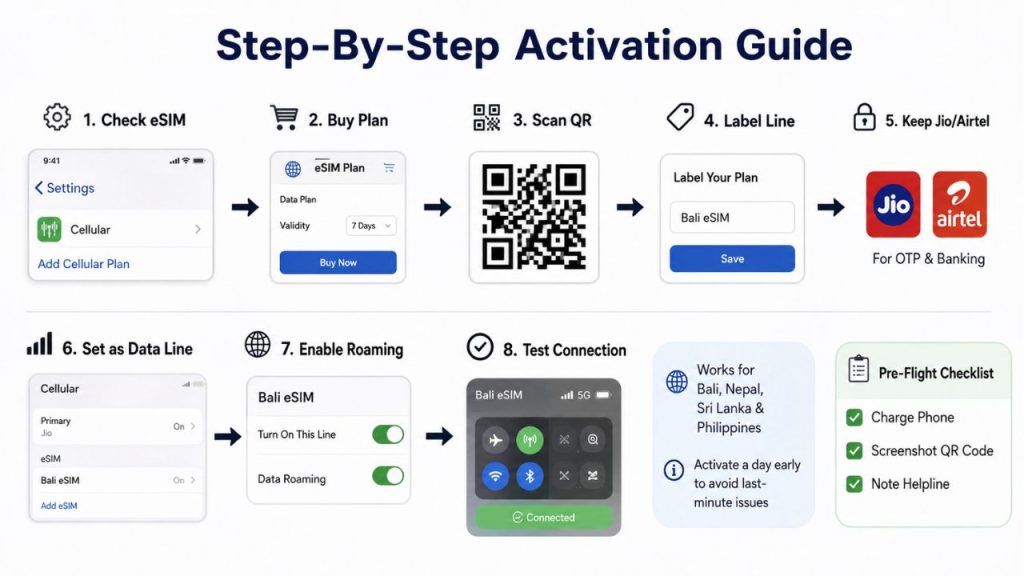
Afterwards, keep your Jio or Airtel line active for OTP and banking alerts. Meanwhile, set the new eSIM as your data line, and enable roaming. Finally, test connectivity before leaving your hotel, since some places need manual APN settings. This India to Bali eSIM activation guide logic applies equally to Nepal, Sri Lanka, and the Philippines.
Before flying, create a checklist: charge your phone, screenshot the QR code, note the helpline. Also, activating a day early gives you time to fix installation errors calmly.
Best eSIM Picks By Traveller Type
Solo backpackers generally prefer flexible short-duration plans, since itineraries change mid-trip. Families, conversely, benefit from higher-data bundles supporting multiple devices via hotspot. Digital nomads need longer validity, often thirty days, paired with dependable urban coverage.
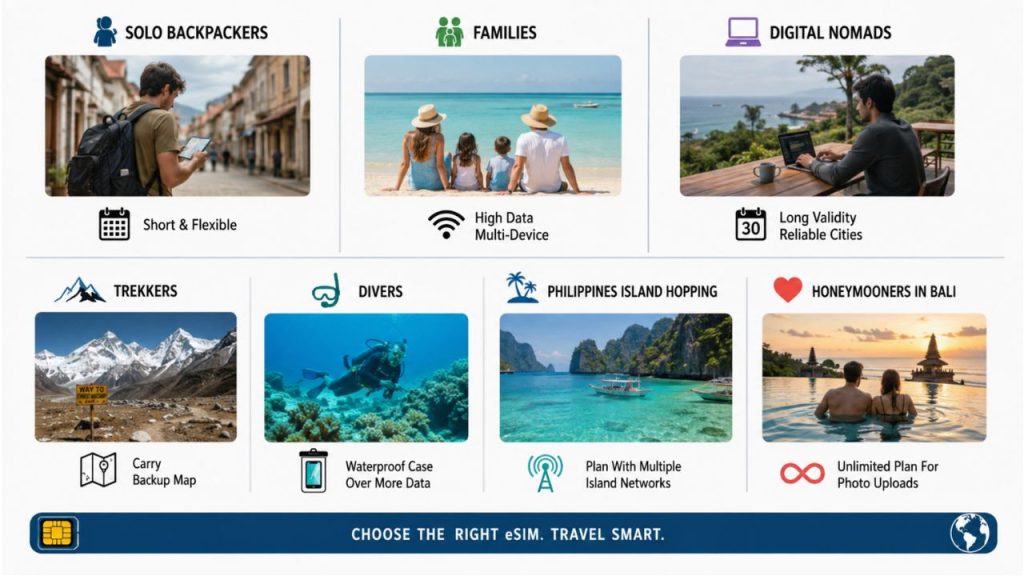
Trekkers heading toward Everest base camp should carry a backup paper map. Divers exploring Philippine reefs near Palawan should prioritise waterproof cases over premium data. For eSIM for Philippines island hopping, choose a plan bundling several islands’ networks together. Similarly, honeymooners choosing an eSIM for Bali often prefer unlimited plans for constant photo uploads.
India-Specific Setup Tips
Indian travellers should keep their Jio or Airtel SIM active for banking OTPs. Dual-SIM phones handle this smoothly, running one physical card alongside one eSIM. Additionally, most providers accept INR payments through UPI, credit cards, or debit cards.
Before flying, download your provider’s app, since some regions block payment gateways after landing. Consequently, purchasing early avoids frustrating payment failures at unfamiliar airport Wi-Fi. Also, screenshot your booking confirmation, since airport lounges often have unreliable Wi-Fi. Overall, this preparation keeps your Indian number safe while the eSIM handles data.
Common Problems And Troubleshooting
Sometimes, signal disappears inside mountain valleys or dense forest cover in Nepal and Bali. In such cases, toggle airplane mode on and off to force network reselection. If APN settings look wrong, manually enter the provider’s recommended access point name.
Similarly, top-up failures usually stem from expired validity windows, not payment errors. So, always check expiry dates before assuming the app has malfunctioned. For unlimited plans, remember that speeds sometimes throttle after a fair-usage threshold. Restarting your device also resolves many stubborn connection glitches quickly. Similarly, keeping a small power bank charged helps when hotspot use drains your battery faster.
Frequently Asked Questions
Does eSIM work in the Everest region?
Coverage exists in Lukla and Namche Bazaar. Signal weakens higher up the trail.
Is eSIM cheaper than roaming for Bali?
Yes, Indian carrier roaming charges usually exceed local eSIM rates.
What about an eSIM data plan for Bali Ubud Canggu Seminyak?
These areas enjoy strong Telkomsel coverage. So, 10GB plans usually suffice.
Can I get an eSIM for Philippines unlimited calls and data plan?
Some providers bundle calls. However, most tourist eSIMs stay data-only.
Is one multi-country eSIM better than four separate purchases?
It depends on trip length. Single-country plans usually cost less per GB.
Do I need a new number for Nepal treks?
No, a data-only eSIM works fine for most trekkers.
Final Verdict And Recommendation Table
Choosing wisely depends on destination, trip length, and how much data you truly need. The table below summarises the strongest pick per country, plus the best combined option.
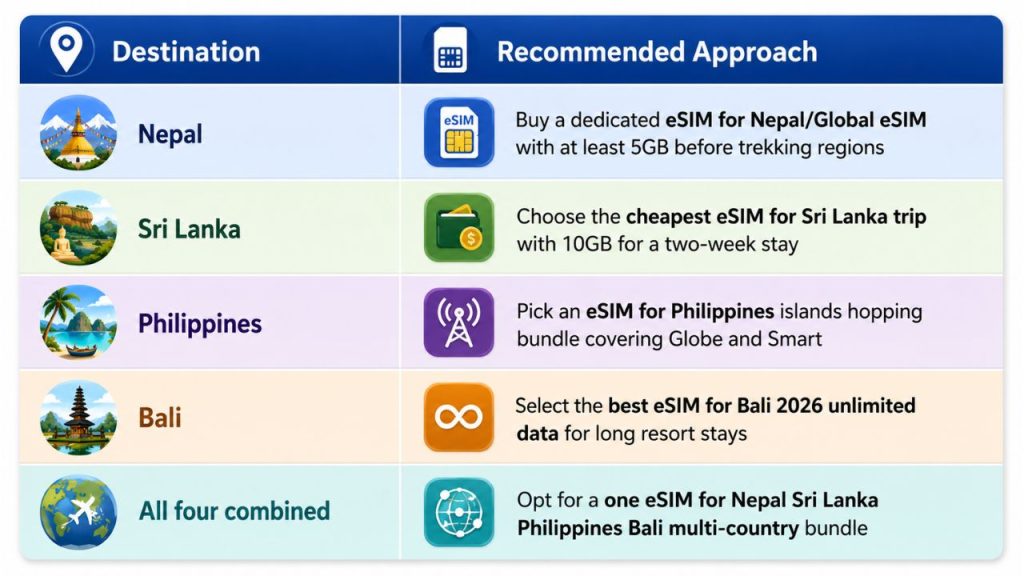
Conclusion And Recommendation
Overall, the best eSIM for Southeast Asia/Global eSIM balances price, coverage, and flexibility over chasing the cheapest listing. Consequently, matching your plan to your itinerary saves money and prevents dead zones. In the end, reliable connectivity lets you focus on temples, beaches, and reefs instead of Wi-Fi hunting. Ultimately, an informed choice today means fewer surprises tomorrow, whether you trek Everest or dive near Palawan.
Travellers who want a hassle-free option can skip comparing dozens of listings. Hubbing Ecom offers competitively priced travel eSIMs. These cover Nepal, Sri Lanka, Philippines, Bali, and beyond. Staying connected affordably matters because it keeps you safe and helps with navigation. It also lets you share memories instantly with family back home. Hubbing Ecom’s eSIM plans activate within minutes and support multiple devices. They also remove the paperwork hassle of local SIM registration entirely, you need to send your soft copy of passport, visa, ticket details with them . Before your next trip, grab an affordable data eSIM directly through Hubbing Ecom. It makes your journey smoother. Hubbing Ecom also provides Physical SIM Card options along with eSIM. The eSIM and Physical SIM recharge, status of usage can be done through their application “SYMBAA”.
Why Connectivity Choice Shapes Your Trip
Good connectivity does more than let you post photos from Ubud or Ella. It helps you book last-minute transport, translate menus, and contact family during emergencies. Therefore, choosing the right eSIM is not a small detail. It is a real safety decision worth planning ahead.
Moreover, many travel apps rely on live data for maps, currency conversion, and ride-hailing services. Without steady data, navigating Manila traffic or Kathmandu’s narrow lanes becomes far harder. So, before your trip, test your eSIM at home first to confirm the QR code installs correctly. This small step prevents stressful troubleshooting once you land in an unfamiliar country.
Additionally, group travellers should assign one person to manage all eSIM top-ups for convenience. This avoids confusion when multiple devices need refills mid-trip across different countries. Furthermore, saving your provider’s support contact in WhatsApp helps when you lack browser access suddenly. These small habits make multi-country travel through Nepal, Sri Lanka, the Philippines, and Bali far smoother overall.
You may like reading similar Blogs
Affordable eSIM for Singapore: Safe High‑Speed Data for International Tourists
Is ‘Unlimited’ eSIM Really Unlimited? The Truth About Throttling & Hidden Data Limits
How Much eSIM Data Do I Really Need? A Calculator for Every Type of Traveler
Complete eSIM Troubleshooting Guide — Why It’s Not Working & How to Fix It
How to Use eSIM Abroad Without Missing Your Indian Bank OTP or UPI Alert
The Greener Future of Travel: Why eSIMs Are the Sustainable Choice for USA Trips
Half Day Kuala Lumpur Tour: Top 8 Must-Visit Attractions in Malaysia’s Capital
Hidden Kathmandu Valley: 7 Non-UNESCO Sites to Explore from Thamel in 2 Days
Global Travel eSIM Explained by a Telecom Professional
Kandy to Sigiriya and Dambulla Day Trip: History, Culture, and Stunning Views
Bandipur Nepal Travel Guide: 7 Unmissable Spots for Nature & Culture Lovers
Kandy Day Trip by Tuk Tuk: Must-See Sights and Local Secrets
Experience Colombo Like a Local: Tuk Tuk Day Trip Highlights
Lumbini Travel Guide: Exploring the Birthplace of Buddha
Top Activities in Sauraha: Jungle Safari, Canoeing, and Tharu Culture
Cebu City Tour Itinerary: Discover Unique Things to Do on the Best Day Trip in Cebu
Subscribe to our YouTube channel and follow us on Instagram page for more updates.

Leave a comment